From Scenic Claim to Booking Standard: EverestViews.com for Verified Mountain-View Stays
October 12, 2026 · 2 min read
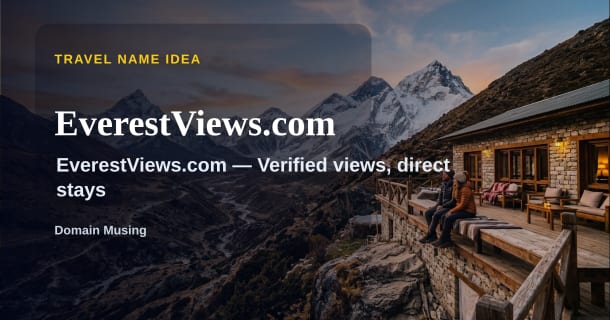
At first, EverestViews.com sounds like a gallery. It could become something more operational: the flagship direct-booking identity for a boutique Khumbu lodge network whose defining amenity is not merely a bed at altitude, but a carefully documented outlook. For an operator trying to move high-intent guests away from commission-heavy OTA reservations, the name could establish verified mountain-view stays as a hospitality category of their own—scenery connected to an actual room, date and reservation path.
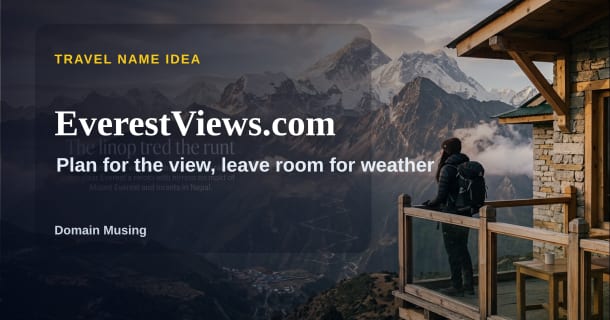
The singular mountain and plural Views create a useful tension: one unmistakable landmark, many guest-facing angles that need to be named honestly. Everest may appear across a shoulder from one terrace, open into a wider panorama from Gokyo, or vanish behind cloud despite a famous location. “Views” also leaves room for the people interpreting what guests see: lodge teams, guides and photographers who can distinguish a beautiful promise from a realistic one. That makes the name broad enough for several properties without reducing Khumbu to one window or summit frame.
The primary scene begins with an EverestViews.com logo lockup on a trusted travel-advisor directory. A traveler opens it and searches availability by panorama rather than by vague room labels: sunrise terrace, Gokyo lake outlook, monastery valley view. Each result identifies the property and room category, with a dated photograph, season, capture location, photographer credit, relevant permissions and editing disclosure. Content Credentials could add provenance where supported, though they cannot prove that conditions are typical or that every visual claim is factually complete. From there, LodgingBusiness, HotelRoom, Offer and ReserveAction-style data can support an agent-readable booking path. The guest selects dates, pays the lodge directly, receives a confirmation from the same domain and enters a private itinerary portal carrying arrival guidance, acclimatization notes and local support details.
This is where a descriptive .com can feel less like advertising and more like category architecture. The name is easy to repeat, credible in a confirmation email and spacious enough to accommodate lodges in Namche, Khumjung, Tengboche or Gokyo under one standard without erasing their individual identities. A compromise name might describe the operator. EverestViews.com describes what the guest came hoping to encounter—and asks the hospitality business to make that promise specific, bookable and accountable.